

The way early human civilizations were divided into eras was very simple: the Stone Age, the Bronze Age, and the Iron Age. These divisions were not based on social systems, nor on ideas or philosophies — they were based on materials. The discovery of a new material often did far more than improve a single product — it could bring an entire industrial chain to life, and even define an era.
This is still happening today. In 2011, Ryoji Kanno at the Tokyo Institute of Technology in Japan discovered a crystalline material called lithium germanium phosphorus sulfide (LGPS). In this powder-like solid material, lithium ions achieved, for the first time, a conduction speed comparable to that of liquid electrolytes. Before this, solid-state batteries were a niche academic topic; afterwards, hundreds of billions of dollars of investment from companies such as Toyota, Samsung, and CATL poured into the field. Solid-state batteries became one of the biggest bets in the new energy industry. Today, this material can be sold for several million dollars per ton.
One material, one industry.
What few people know is that, in order to discover LGPS, Ryoji Kanno spent more than two decades searching within the lithium–phosphorus–sulfur system. His method was the same as that of all materials scientists for thousands of years — relying on experience and intuition, narrowing down the search space, and then testing materials one by one.
Today, AI is attempting to change this equation.
From (Skeptic) to (Entrepreneur)
Kaiwu Ji founder Lu Ziheng’s confidence in this idea has a clear starting point.
He studied mechanics at Nanjing University of Science and Technology and later pursued his PhD at the Hong Kong University of Science and Technology, where he worked on computational simulations of solid-state electrolytes. When applying for his PhD, he wrote a research proposal that now seems somewhat naive: using molecular simulations to simulate everything in the universe. His advisor Francesco read it, smiled, and said it sounded good.
“Later, I realized that the scale was simply too large. It was fundamentally impossible,” Lu Ziheng said with a bitter smile.
This experience made him continuously question computational methods. After spending two years doing simulations, he felt that “it was not grounded enough; I had never seen what the materials actually looked like.” He went to Yale to learn a complete set of experimental techniques, returned to Hong Kong to build a laboratory, and spent the following years mainly conducting experiments. After completing his PhD, he joined the Shenzhen Institute of Advanced Technology at the Chinese Academy of Sciences, where he worked as a faculty member for three years, supervised ten master’s students, and simultaneously attempted to scale up laboratory achievements toward industrialization.
During that period, he was “quite disappointed” with computation and AI.
Materials science has an uncomfortable reality: over the past several decades, many of the field’s core breakthroughs have often depended on the intuition of a small number of genius scientists. Among the most important cathode materials for lithium batteries, at least two major categories were directly proposed by Goodenough (LiCoO₂ and LiFePO₄), while other systems (such as LiMn₂O₄ and lithium-rich manganese-based materials) were also built upon the transition-metal oxide theoretical framework he established.
“I don’t even know why he was so smart,” Lu Ziheng said. “That is exactly what we are trying to change. I may not be that smart, but I want to make AI that smart.”
Democratizing genius — this is a proposition that sounds extremely ambitious, yet is also very concrete.
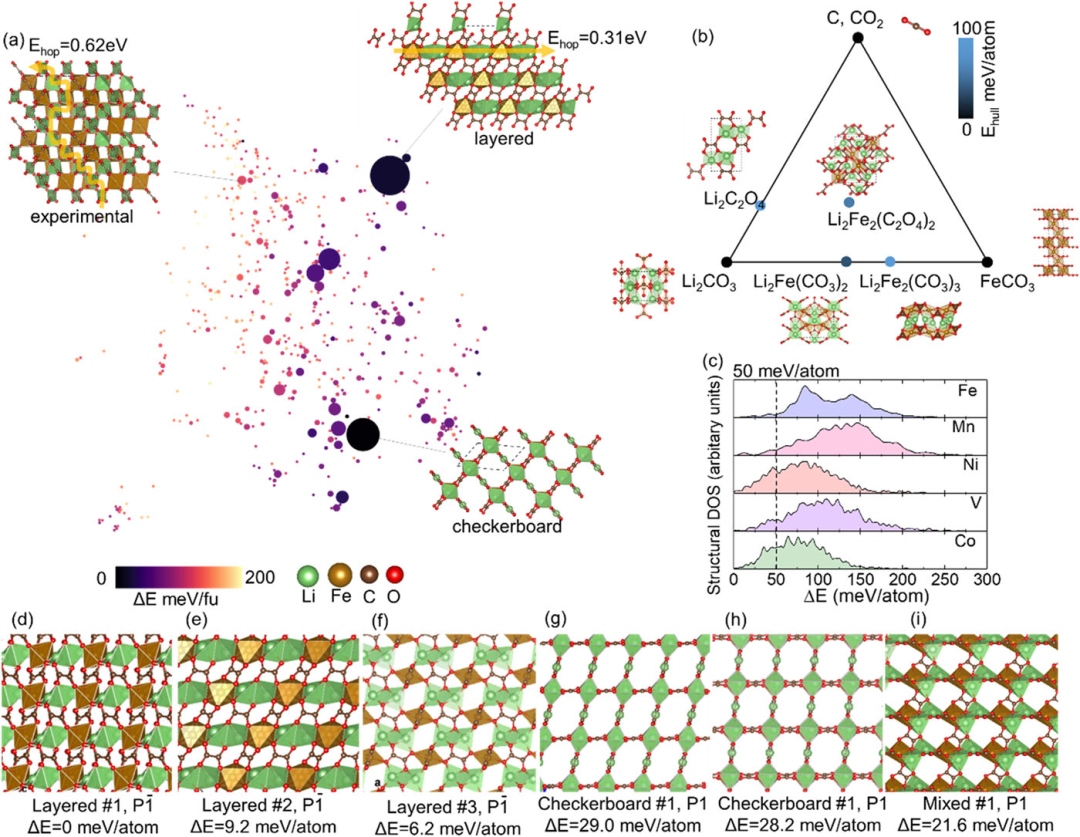
The turning point came in Cambridge. From 2020 to 2022, while working as a postdoctoral researcher at the University of Cambridge, he used an algorithm called random structure search combined with small-scale AI models to search for inexpensive lithium battery cathode materials. They actually found one — a manganese-containing oxalate cathode material. Although its performance was not particularly impressive, it was a completely new compound, and it was successfully synthesized in the laboratory.
“That was the first time I felt that computational predictions could actually become real. And that AI was genuinely useful.”
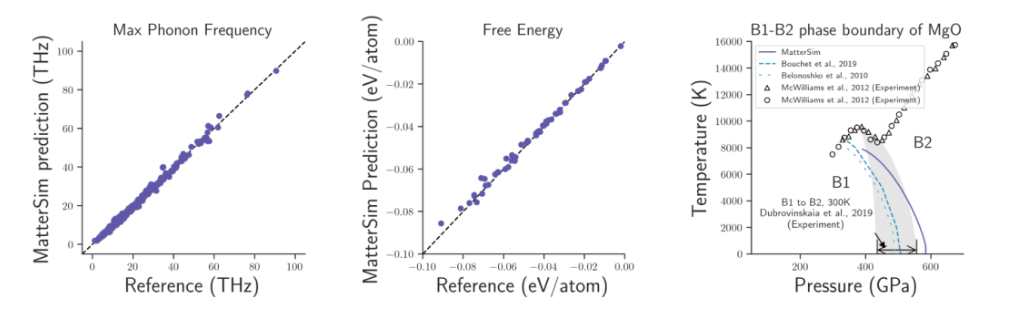
In 2022, he joined Microsoft Research Asia with a very clear goal: to build larger models. During the period before the release of GPT-3.5, AI for Science was a direction that carried enormous expectations — computer vision had reached a mature stage, language models had not yet taken off, and both academia and industry were looking for the next major breakthrough story. Lu Ziheng led a team to begin training a model called MatterSim — given the positions and types of atoms, it predicts the energy and forces between them, as well as various physical properties derived from these quantities.
What he wanted to achieve was a continuation of the naive idea he had during his PhD: one model that could calculate any material.
No one on the team believed this would work.
At the time, a senior condensed matter physicist gave Lu Ziheng a very simple challenge: forget about everything in the universe — just pick a few materials and accurately calculate their phonon spectra. This is a fundamental physics concept taught at the undergraduate level, and at the macroscopic level it corresponds to properties such as heat capacity.
“You cannot even accomplish this. Don’t talk about anything else.”
“To be honest, I was also nervous inside,” Lu Ziheng admitted. “But I told everyone that it would 100% work. It definitely could.”
They began feeding more data into the model and increasing the parameter scale — essentially following the same path that GPT had validated: scaling.
Until one day, they decided to evaluate it.
“After we tested it, no one argued anymore. No one said anything. We just kept our heads down and continued working.”
The model surpassed all specialized models designed specifically for this property on a standard benchmark called MatBench. This meant that a general-purpose large model capable of calculating any material could actually outperform specialized models designed for a specific task. This followed the same logic that emerged in the language model field — sufficiently large general models would eventually surpass all specialized models.
This became one of the fundamental sources of confidence behind Lu Ziheng’s decision to start a company. In 2025, he left Microsoft and founded Kaiwu Ji.
The company’s name comes from Song Yingxing’s Tiangong Kaiwu, a work from the Ming Dynasty that is considered the first systematic encyclopedia in Chinese history documenting materials and manufacturing techniques, covering almost every major industry from ironmaking and ceramics to textiles.
Why Is It Different
There is a significant gap between confidence and reality.
AI for materials is not a new concept. Many companies have been working in this field for years and have achieved considerable academic influence, but commercialization has progressed slowly. Companies in China and overseas have taken different approaches: some focus purely on algorithms, some focus on automated laboratories, and some place their bets on quantum chemistry calculations. But they are all trying to answer the same question: can general-purpose large models truly work for materials discovery?
Google DeepMind’s GNoME predicted 2.4 million potentially stable new materials in 2023, but subsequent experimental synthesis validations found that many predictions were not reliable. There is a recurring storyline in this field: AI predicts an excellent material, but the laboratory cannot make it. Computational scientists say, “Your experimental capabilities are insufficient”; experimental scientists say, “Your predictions are unreliable.”
What is the root cause of this contradiction?
Materials science faces a challenge fundamentally different from drug discovery: solid-state synthesis. In pharmaceutical laboratories, most operations involve liquid handling — mixing, dispensing, and stirring. These processes have already been highly automated by high-throughput robots. But materials research requires inorganic powders to be mixed at precise ratios and sintered under specific temperatures and pressures — processes that are far more complicated than liquid handling and much less automated.
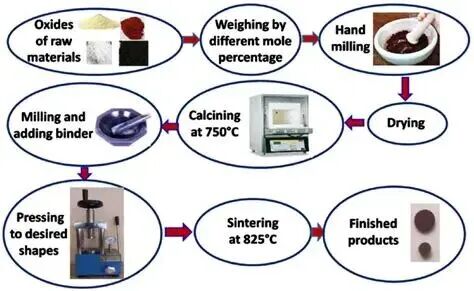 Typical process flow of solid-state synthesis
In other words, even if AI predictions are accurate, there is still a long path from prediction to synthesis, validation, and large-scale manufacturing — a path where AI currently cannot provide much assistance.
Lu Ziheng understands this very clearly. He himself has worked across both computational and experimental worlds — learning synthesis techniques at Yale, conducting industrial scale-up research in Shenzhen, and personally synthesizing AI-predicted new materials during his time at Cambridge. Therefore, from the very first day of founding the company, Kaiwu Ji built both an AI team and an experimental team, while insisting that the two groups could not operate separately.
“They must be one team. People doing AI need to have an above-average understanding of condensed matter physics; experienced experimental scientists need to have a systematic understanding of AI. Everyone must speak the same language.”
The method of collaboration was simple: the two teams were required to have lunch together every day.
“Just chatting casually during meals solves the problem.”
The practical effect of this integration is that when the model predicts candidate materials, the laboratory next door begins synthesis verification the following day. If the material works, the data is fed back into the model to improve its accuracy. If it fails, the two teams sit down together to determine the reason, adjust the approach, and try again. This accelerates the feedback loop.
In addition, AI for materials has a fundamental difference from large language models. The training data for language models is fixed — the text corpus of the entire internet is already there. What you need to do is train a sufficiently large model to absorb it. But the materials field does not have such a massive existing database. The material data accumulated throughout human history is negligible compared with internet-scale text data.
“So for us, the bottleneck is more about data, not models.”
This means Kaiwu Ji is not only training models — it also needs to create data. They use quantum chemistry calculations (DFT) to generate large amounts of synthetic data, while simultaneously producing experimental data through their own laboratories. Model training and data generation advance together: the model predicts candidate materials, the laboratory validates them, and the validation results become new training data.
“This follows the same logic as embodied intelligence,” he said. “At the beginning, embodied intelligence did not have enough real-world data either, so researchers started with simulation. Later they discovered that there was a sim-to-real gap, and they began creating data in the real world. Materials are the same — you first need to create an environment where data can scale, and then scale the model together with it.”
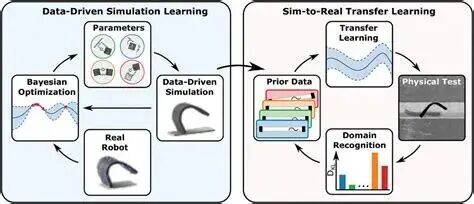 The sim-to-real pathway in embodied intelligence
From Twenty Years to Six Months
“If you brought Kaiwu Ji’s model back to 2011, could you find LGPS faster than Ryoji Kanno did?” we asked Lu Ziheng a hypothetical question.
“I think it probably could, and it would be faster than him.” He paused. “I don’t want to make too absolute a statement, but I estimate that six months should be enough. He spent more than twenty years.”
During his time at Cambridge, he had already conducted similar retrospective tests — inputting the elemental combinations of several known important solid-state electrolytes into the model and testing whether the model could “rediscover” them. The result was yes. Lithium lanthanum zirconium oxide — a solid electrolyte second only to LGPS, with an extremely complex structure — could also be found.
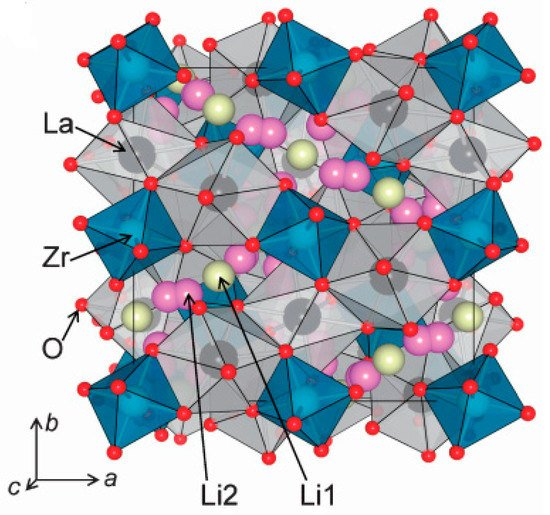 Schematic illustration of the lithium lanthanum zirconium oxide (LLZO) crystal structure that could be rediscovered by the model in retrospective testing
“This is also why we believe AI is genuinely useful — things that could not be found using traditional methods were discovered with the assistance of AI.”
Of course, retrospective validation and true frontier discovery are two different things. Finding known high-performance materials proves that the model has the capability, but the question that truly excites the field is still this: can it discover excellent materials that humans do not yet know about?
Lu Ziheng’s answer is:
“AI has already discovered some useful new materials, including some that we ourselves have found. But that truly groundbreaking discovery — the one that defines an entire industry? It has definitely not happened yet.”
He sees this as a matter of time, not a matter of direction.
“The technological prerequisites are already in place. Scaling works for materials prediction, general models have begun to surpass specialized models, and our laboratories can rapidly validate predicted results. What we need now is time — to search through a sufficiently large chemical space, and to complete the entire pipeline from discovery to validation to mass production.”
The directions Kaiwu Ji is exploring next fall into two categories.
One category is about “making big money”: energy is the biggest theme. The fundamental driving force behind the AI industry itself is energy, and in the end, the competition will also be about energy — energy storage, power batteries, and energy conversion materials all fall into this category. Moving further toward the edge are those “small materials with huge leverage” embedded in industrial supply chains — for example, the special adhesive required for the inner walls of spherical storage tanks on ocean-going LNG carriers, which must remain stable under extremely low temperatures and extremely high pressures. This material has an extremely high unit price and has long been controlled by several foreign companies. These are categories with clear technical bottlenecks and supply chain constraints, where AI’s search capabilities may have the greatest opportunity to make breakthroughs.
The other category is about “demonstrating technological strength”: superconductors are the classic example. Whether room-temperature or even ambient-pressure superconducting materials can be discovered remains the holy grail of condensed matter physics for decades. Another example is first-wall materials for nuclear fusion — alloys or ceramics capable of withstanding the impact of plasma at temperatures of hundreds of millions of degrees inside fusion reactors. These areas may not generate immediate profits, but once achieved, they could redefine the boundaries of human energy.
Returning to the business model, Kaiwu Ji has a very clear strategy: first, prove a complete closed loop internally — AI discovers materials, laboratories synthesize and validate them, production is scaled up, and products are delivered to customers. Lu Ziheng compares this approach to Flagship Pioneering — the biotech venture firm that incubates companies from early-stage compounds into world-class enterprises and created companies such as Moderna. He hopes Kaiwu Ji can build a similar path in materials science.
This is not cheap. Today, the two most expensive resources are computing power and AI talent, especially the latter, which is significantly more expensive than other types of talent in the same industry.
Monolith led Kaiwu Ji’s angel-plus funding round. Lu Ziheng said that his first impression when entering Monolith’s office was unforgettable:
“After walking in, I felt that it was completely different from other investment institutions. It was extremely minimalist, the glass walls were transparent, and the people inside were very young — it did not feel like an investment firm, but rather like a tech startup.”
In addition, his conversations with Monolith founder Cao Xi progressed unusually smoothly. Both sides quickly reached consensus on technical direction and business judgment. The entire decision-making process was concise and direct.
“It was the institution with the highest communication efficiency among all the ones I have worked with.”
A Paradigm-Level Leap
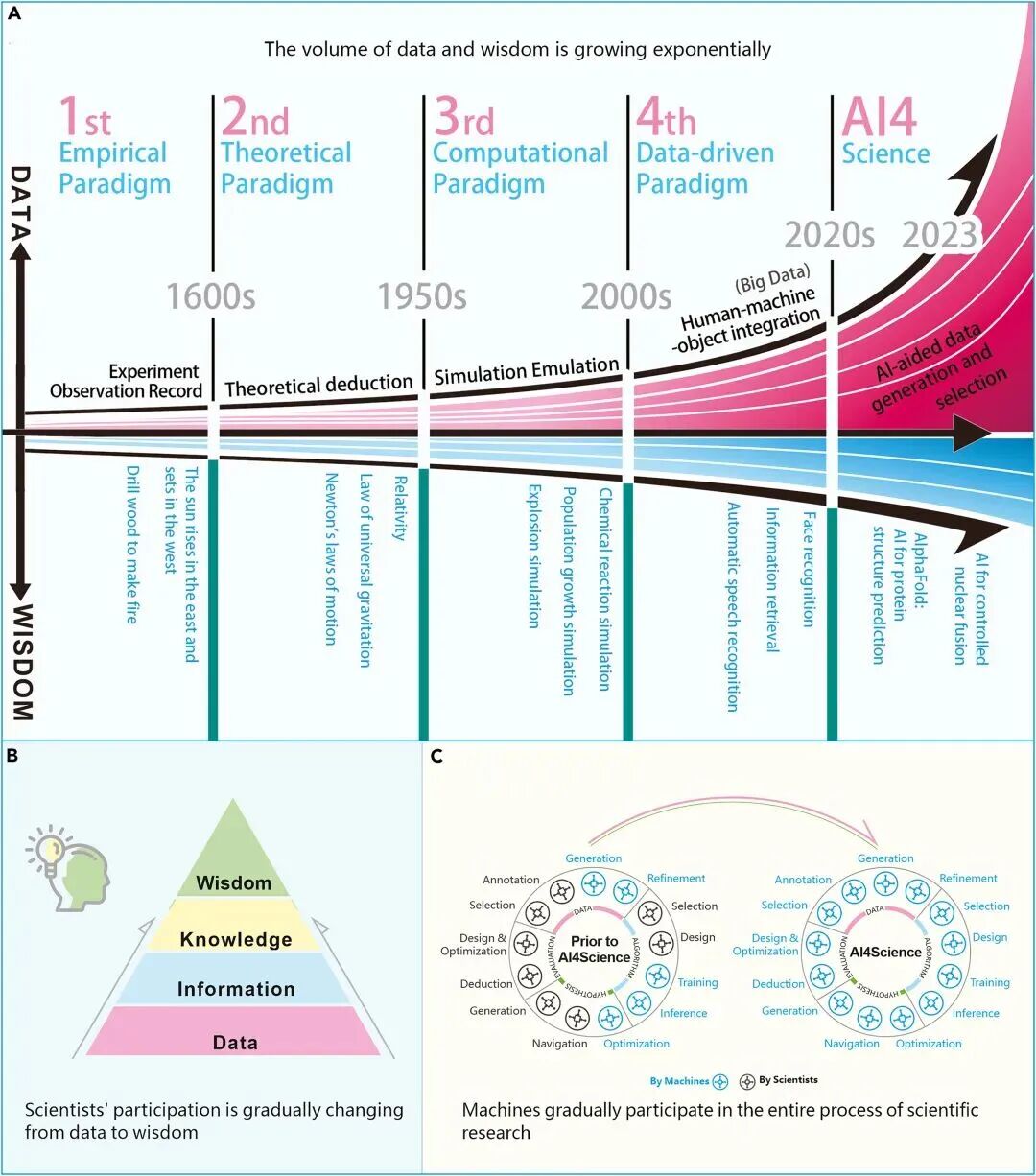
Looking back through history, humanity’s ways of understanding the material world have undergone only four fundamental transformations:
The first was empirical trial and error. For thousands of years, material discoveries relied on this approach.
The second was theory-driven discovery. Thermodynamics and quantum mechanics allowed humanity to begin describing the laws of matter mathematically.
The third was computational simulation. After the emergence of computers, scientists could conduct part of their experiments on screens.
The fourth was data-driven discovery. When the amount of data reaches a certain scale, statistics themselves can reveal hidden patterns.
Materials science is an ancient yet critically important field. Humanity’s pursuit of new materials has never stopped — higher energy-density batteries, more efficient solar cells, more heat-resistant alloys, and cheaper catalysts. If discovered, each of these materials could potentially unlock markets worth hundreds of billions of dollars.
Now, AI offers a fundamentally different possibility: no longer relying on the intuition of a small number of genius scientists, but instead using models to systematically search the entire chemical space. It changes not only efficiency, but the paradigm itself. The fifth paradigm is arriving. This is also the significance represented by companies like Kaiwu Ji.
The Fifth Paradigm: AI for Science
The deeper meaning of AI for Science is not merely making scientists work faster, but making previously impossible things possible. This applies to materials science, drug discovery, and protein structure prediction. When AI begins to intervene in fields that represent the deepest levels of human intelligence, the largest search spaces, and the most fundamental impacts on civilization, what it brings is no longer incremental improvement, but a paradigm-level transformation.
What will be the next material to define an era? Perhaps it will be the electrolyte that finally enables large-scale production of solid-state batteries. Perhaps it will be a photovoltaic material that doubles solar efficiency. Or perhaps it will be some entirely new substance that we cannot even imagine today — one that may be hidden somewhere in chemical space, in a corner that human intuition could never reach.
In the past, finding it required a genius scientist spending twenty years.
Soon, perhaps, it will no longer be necessary.